



Surgical light backup power must be accepted at the far end of the installation: where light reaches the surgical field. A charged battery and a ready indicator provide only part of the evidence. It remains necessary to check that the alternative supply reaches the light, that its controls still respond and that the observed behaviour meets the project requirements.
This distinction matters when replacing a luminaire, renewing its power supply or accepting an operating theatre. The wiring may remain while the electronics receiving the power change. One light head may also stay on while another loses power. The acceptance record must describe the assembly tested and the conditions of the test, without extending the result to components outside its scope.
The approach is to follow two related lines of evidence: electrical evidence, from the supply to the load, and functional evidence, from the load to the illumination produced. Both must be traceable to the same configuration and the same test.
Defining the scope of surgical light backup power
The first useful document is a diagram that allows the supply to each light head to be traced. It should identify the normal source, the backup source, the transfer components, protective devices, connections and controls involved in operation. It need not become a plan of the entire hospital, but it must include any dependency capable of interrupting that function.
Two visible light heads do not demonstrate two independent supplies. They may share a source, a protective device or a section of cable. These common points should be identified, and the capabilities of the installed configuration checked. The number of heads and the degree of redundancy are different matters.
Surgical lighting, general room lighting and escape lighting must also be distinguished. They serve different purposes. The official description of IEC 60601-2-41:2021 includes surgical and diagnostic luminaires within its scope and excludes emergency lighting luminaires. The fact that emergency lighting comes on does not establish that the surgical light has backup power.
The diagram should be accompanied by the exact equipment references and their instructions. A generic description such as “dual LED surgical light” is insufficient to check permitted voltages, connections, dimming or behaviour on loss of power. The review begins by identifying what is installed, rather than assuming it has features common to other models.
An installation requirement and an equipment specification
In Spain, section 2.2 of ITC-BT-38 in the Low Voltage Electrotechnical Regulation requires a special supplementary supply for the operating or intervention room light and life-support equipment. It specifies automatic operation within less than 0.5 seconds and a runtime of at least two hours. It also states that the light must be supplied through an isolation transformer.
These requirements apply within the scope of the Spanish instruction. They should not be transferred to another country without review or presented as product certification. The design must address the complete system and its compatibility with the selected equipment.
A manufacturer’s data sheet, by contrast, describes a particular unit. A declared transfer time or runtime helps with selection and defining checks, but does not replace verification of the installation. Between the power supply output and the light are connections, controls and electronics whose behaviour also matters.
The acceptance documentation should distinguish three records: the applicable requirement, the equipment’s declared performance and the measured result. If these are conflated, a catalogue figure can end up being recorded as the result of a test that was never performed.
Halogen and LED: check the interface before replacement
Renewing surgical lights requires more than a comparison of power ratings. The type of supply, permitted voltage range, polarity where relevant and control compatibility all need to be checked. A lower-power load may still be incompatible with the available output.
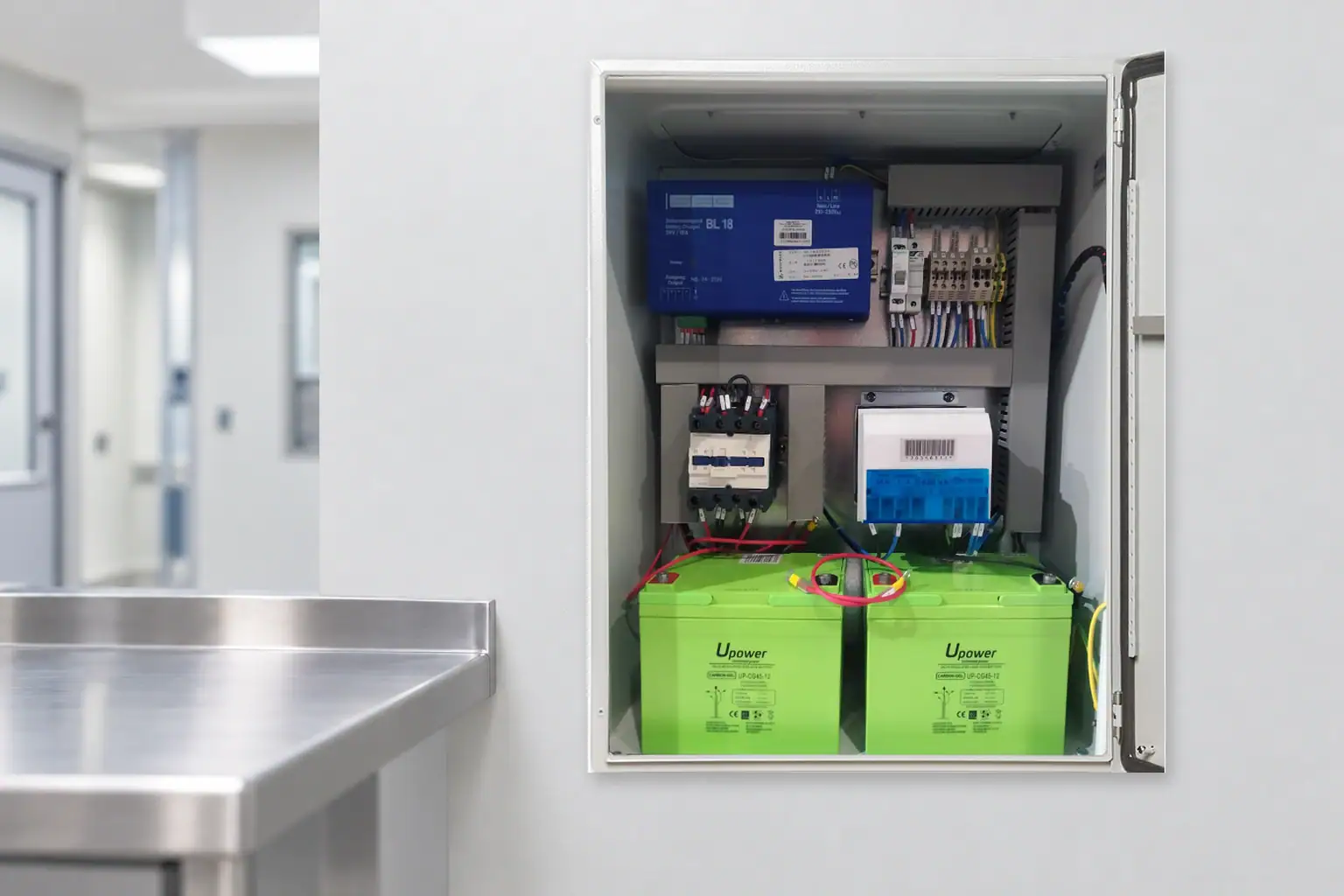
ETKHO’s data sheets show why this review deserves specific attention. The ETK EPU-H is intended for halogen lights; it specifies a nominal 24 V AC output with mains power and a 24 V DC output, subject to the tolerance stated in its data sheet, without mains power. The ETK EPU-L, intended for LED lights, specifies DC output in both states.
| Criterion | ETK EPU-H | ETK EPU-L |
|---|---|---|
| Stated application | Halogen lights | LED lights |
| Output with mains | Nominal 24 V AC | Nominal 24 V DC |
| Output without mains | 24 V DC, +10% as stated | Nominal 24/27.5 V DC as stated |
| Declared automatic transfer | Less than 0.5 s | Instant |
| Declared runtime | Two hours | Two hours |
“Instant” reproduces the declaration in the EPU-L data sheet; it is not treated here as a measured time or a test tolerance. Similarly, the 500 W power supply rating does not, by itself, demonstrate two hours of backup at that power. Selection should be finalised only after confirming the runtime conditions for the proposed version and load.
The data sheets describe wall mounting in a technical area. The location should allow access, identification and maintenance in accordance with the manufacturer’s instructions and the design. A sound equipment choice loses its value if the unit is concealed, lacks working space or cannot be reliably matched to the light it supplies.

The electrical test and the observation of light must align
An acceptance test needs criteria defined before it begins. The record should identify the loss of supply being represented, the connected equipment, the settings used and what will be observed. It should also define the conditions for stopping the test and the procedure for restoring service.
The test is prepared outside the affected clinical activity, with the authorisations and competent personnel required by the installation and the manufacturers. This approach does not prescribe switching operations or invite deliberate faults during surgery. If other loads are affected, the scope should be coordinated through a hospital power shutdown plan.
What happens during the supply transfer
Seeing that the light remains on provides useful information, but cannot by itself establish a time interval of less than half a second. Timing assessment requires a defined starting event, a measured quantity and a known recording resolution. An instrument that averages over too long a period may conceal the event being investigated.
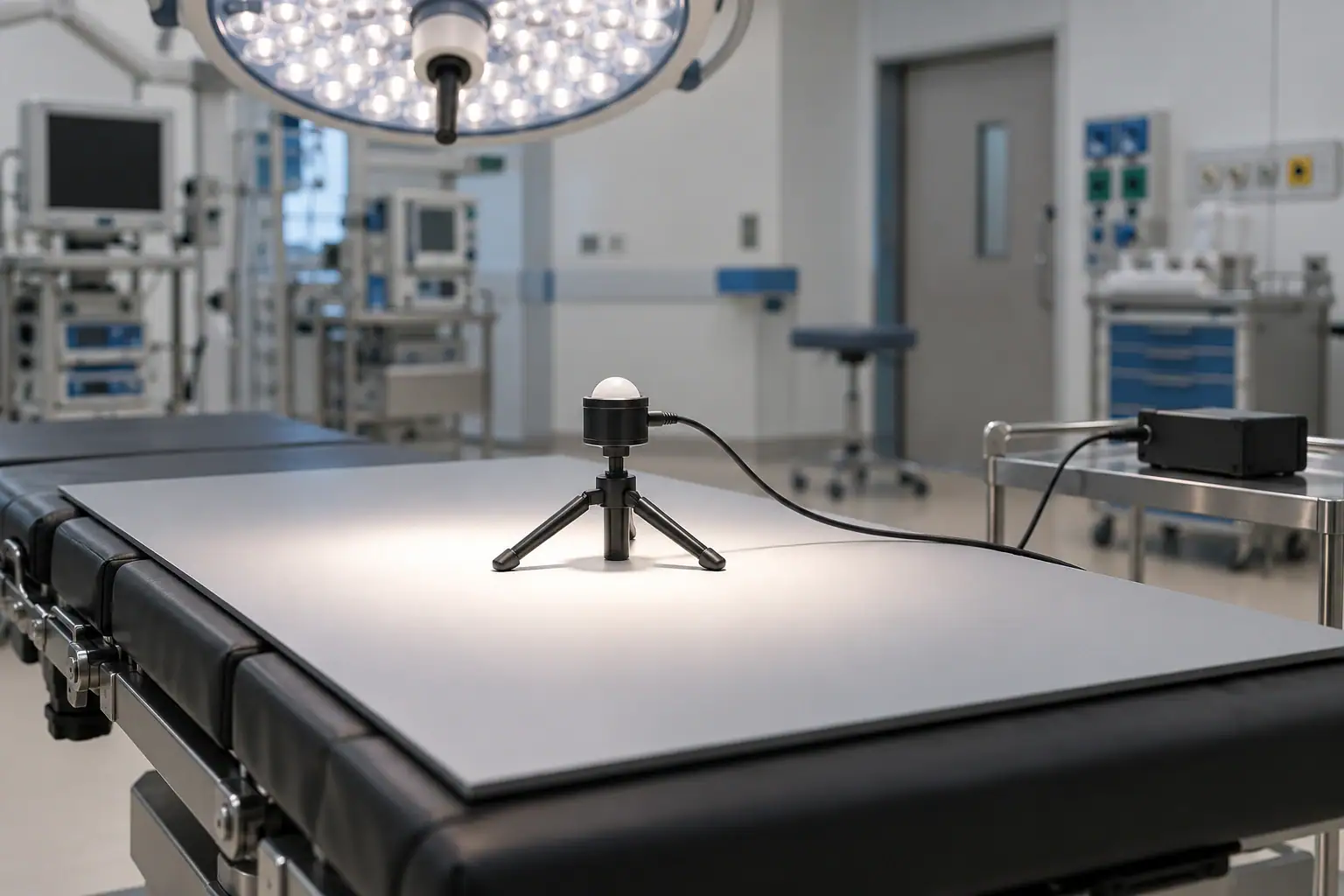
The proposed approach links the supply recordings at the points specified in the procedure with the light output response. Measuring equipment must suit each quantity; a lux meter intended for steady readings does not necessarily establish the duration of a brief interruption. Instrument selection is the responsibility of those designing and carrying out the test.
The controls that contribute to the function should also be checked: switching, dimming or other functions applicable to the model. If the light stays on but a control stops responding, the result should describe that distinction. A generic “working” tick box does not retain enough information.
What happens while backup power is in use
Transfer testing and runtime testing answer different questions. The former examines the change of supply; the latter assesses whether the function is maintained for the required duration. A successful brief test does not establish the outcome of the runtime test.
Before assessing duration, record the load configuration, the initial condition of the backup source and the stopping criteria. Where there are several light heads, the record must identify which are included and their settings. A report should not refer to the runtime “of the operating theatre” when only part of its lighting has been checked.
Hospital UPS runtime verification examines the energy reserve itself. For a surgical light, functional checks of the luminaire and its controls must be added. Continued power delivery is insufficient if the lighting configuration intended to be supported is no longer available.
The return to the normal supply is also within scope. The final state of the light, its controls and the backup unit should be observed, together with the indications needed to confirm that the system has returned to its intended condition. After discharge, backup availability must be checked in accordance with the relevant instructions, rather than assumed.
Interpreting results without overrelying on a single measurement
A test is more useful when it helps narrow down a discrepancy. The relationships below guide investigation; they are not automatic diagnoses. Before attributing a cause, confirm that the measurements describe the same instant and the same configuration.
| Observation and scope | What to check next |
|---|---|
| The source indicates that backup is available, but there is no light. The source indication does not demonstrate the complete function. | Actual supply at the load, connections and controls, following the procedure. |
| Voltage is present at the source output, but not at the specified input point of the light. There is a difference between the observed points. | The intermediate supply path, protective devices and connection, using authorised checks. |
| The electrical input meets the specified criterion, but the light output response does not. Functional acceptance has not yet been established. | Compatibility, luminaire electronics, settings and measurement conditions. |
| One light head continues to operate and another does not. The result differs between heads. | Supplies, shared dependencies and the actual scope of backup provision. |
| Transfer is satisfactory, but the required duration is not achieved. Transfer has been verified; runtime does not meet the criterion. | The tested load, initial conditions and backup source behaviour. |
This interpretation avoids replacing a battery on intuition whenever an anomaly occurs. It also avoids the opposite mistake: dismissing a backup problem because voltage is present at a point that does not represent the actual supply to the light.

The acceptance record must allow the check to be repeated
A result without an identified configuration quickly becomes difficult to use. When a light head or power supply is next replaced, it may be unclear whether the result still applies. The record should retain equipment references, the diagram used, included loads, settings, instruments, results and incidents, together with the date and those responsible.
Attach the relevant recordings, not just a photograph of the final display. If a test is repeated after an anomaly has been corrected, retain both results and explain what changed. This traceability distinguishes a demonstrated improvement from a difference caused by the procedure or load.
ITC-BT-38 provides for checks of supplementary supplies and the recording of checks and anomalies in the maintenance log. The format of the acceptance record can be adapted to the hospital’s document management system, provided it retains the necessary information and responsibilities.
An apparently equivalent replacement warrants a review of the scope of the earlier acceptance. Changing the light type, modifying controls or connecting another head may alter what was verified. The record should identify changes that require compatibility to be reviewed and tests to be repeated, in accordance with the design and the manufacturers’ instructions.
The useful outcome is a bounded conclusion: which configuration meets the criteria, what evidence supports that finding and what limitations remain. The next technician can then reconstruct the decision without relying on a “checked” label.
Frequently asked questions about surgical light backup power
What should be checked in surgical light backup power?
The power supply must be checked for compatibility with the light and its controls, together with the supply path and the assembly’s response during transfer, operation on backup power and return to the normal supply. The result must be linked to an identified configuration and the criteria applicable to the project.
Can an LED surgical light use the power supply of a halogen light?
Compatibility must not be assumed. Check the current type, voltage range, connections and controls accepted by the luminaire. The ETK EPU-H and ETK EPU-L data sheets describe different applications and outputs; a lower power rating for the new light does not resolve compatibility.
Do two light heads mean that the power supply is redundant?
No. The heads may share a source, a protective device or part of the supply path. Independence is checked against the diagram and the installed configuration. The test must identify which heads are included and what happens to each within the defined scope.
Does a brief transfer-to-battery test demonstrate two hours of runtime?
No. Transfer and runtime tests verify different aspects. Duration must be assessed with the load and conditions defined for the test, following the relevant instructions. A successful brief test does not establish how long the function will be maintained.
Does the room’s emergency lighting replace surgical light backup power?
It does not establish that function. Emergency lighting and surgical lighting serve different purposes. Verification must address the surgical light, its supply and its controls, without inferring availability from other room lighting coming on.
Review the supply before accepting a new surgical light
When selecting a backup unit or reviewing a replacement, start with the luminaire reference, its electrical documentation, the existing diagram and the intended operating conditions. ETKHO’s electrical safety advice supports a review based on the project data and helps define the information needed to select a solution.