



Planned power shutdowns in hospitals begin long before a switch is opened and end after power has been restored. Preparation means establishing the actual scope, agreeing which activities can continue, checking alternative supplies and deciding who will accept the return to service. A scheduled time slot does not settle those decisions.
A planned shutdown is the deliberate removal of power from a defined part of an installation so that work can be carried out on it. In a hospital, planning must connect every affected circuit to the services that depend on it. Electrical and clinical teams need to work to the same scope.
Replacing a protective device may leave an operating theatre untouched yet affect a system needed to use it. Two questions therefore need separate answers: can the electrical work proceed under the proposed conditions, and can the hospital manage its consequences throughout the intervention? That decision requires documentation specific to the installation and the work.
Planned power shutdowns in hospitals: define the scope before setting the date
A work order that says “maintenance of the floor distribution board” leaves too much room for interpretation. The scope needs unambiguous references to the board, feeder, affected devices, work boundaries and circuits that will remain in service. Drawings are a starting point; their correspondence with the installation must be checked.
The Health and Safety Executive’s HSG85 guidance warns against assuming that labels are correct without appropriate verification. It also distinguishes disconnection from isolation secured against accidental reconnection. This is UK good-practice guidance, not Spanish legislation or certification of an installation.
During preparation, trace the scope in both directions: from the device to its loads, and from the clinical service back to its supplies. This can reveal dependencies that a socket list misses, such as communications, access control, auxiliary equipment or support services. Not all will be present or affected; the inventory must describe what actually exists at that hospital.
The useful outcome is a marked-up drawing accompanied by a list of services, reviewed by the people responsible for them. An unidentified circuit leaves uncertainty about the scope that must be resolved before the shutdown is approved. Managing the hospital electrical system requires this correspondence between circuits and services to define the boundaries of an intervention.

Continuity must be agreed service by service
Asking whether backup power exists invites an answer that is too simple. For a particular intervention, the team needs to know which supply path will feed each load while its normal supply is unavailable, and which parts of that path will also be affected. An available source does not prove that power can reach the equipment.
A practical planning approach is to classify services by what happens during the shutdown: activities that stop, activities that move elsewhere and activities that continue with a validated alternative. The hospital makes that classification, involving clinical, engineering and medical engineering staff as the scope requires. It should not be inferred solely from socket colours or distribution-board names.
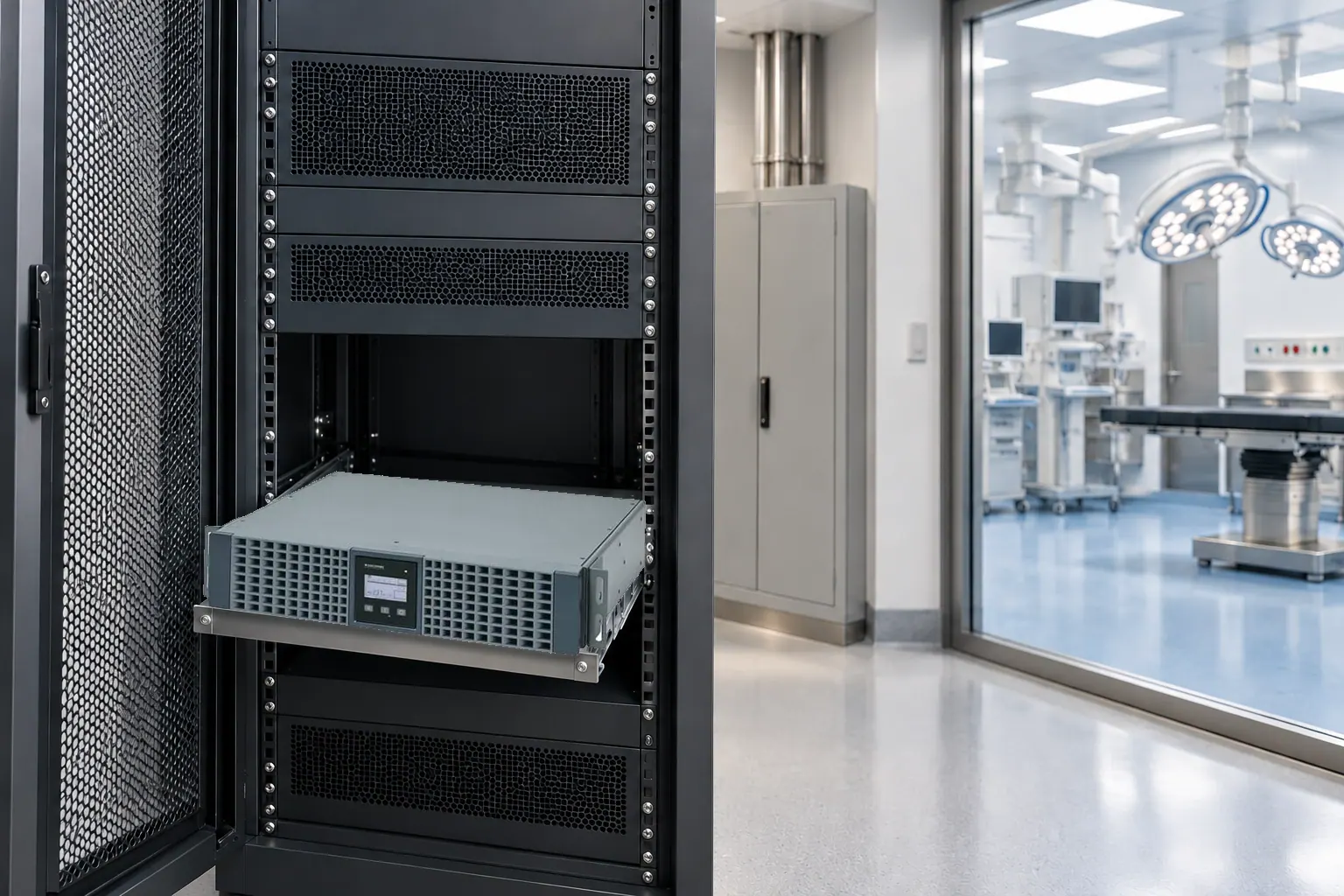
Where an uninterruptible power supply (UPS) is involved, review its condition, the expected load and its configuration during the work. Verifying hospital UPS runtime establishes the available duration; the shutdown plan must also state what happens if that reserve becomes insufficient or the alternative fails before the work is complete.
ETKHO documents uninterruptible power systems in its ETK UPS range. The presence of a UPS in a project does not establish that work can take place at any point upstream or downstream while all loads remain supplied. That depends on the topology, isolation devices, configuration and instructions for the installed equipment.
The bypass needs a separate check. If the plan uses an alternative path, determine which protective measures and backup supplies remain available in that state. The plan should record the accepted configuration. An instruction to “switch to bypass” is insufficient, as is assuming that every model permits the same operation.
A shutdown plan needs acceptance criteria
Each decision needs supporting evidence if approval is to mean more than a signature. The table below proposes how to connect decisions, evidence and responsibilities when preparing the work documentation. Specific responsibilities and authority must be assigned under the hospital’s organisation and applicable law; a role title does not authorise someone to carry out electrical work.
| Decision | Evidence to review | Proposed involvement |
|---|---|---|
| What will be affected | Verified drawing and list of circuits and services | Engineering and maintenance, with service managers |
| Which activities can continue | Defined alternative and accepted operating conditions | Clinical lead, engineering and medical engineering where appropriate |
| When work may begin | Safety conditions and work authorisation under the applicable procedure | Personnel with the required electrical authority and those coordinating occupational safety |
| When work must stop | Stop conditions and response to loss of the alternative supply | Person responsible for the work and hospital coordination team |
| When the area may be used | Work completion, relevant checks and functional acceptance | Engineering, maintenance and managers of the affected services |
The documentation also needs a single communication channel, contacts who can respond throughout the intervention and an identifiable version of the plan. Where contractors are involved, the limits of their work must be agreed with the installation operator. A shift change requires an explicit handover of responsibilities and the current state of the work.
The time window must cover preparation, the intervention itself, checks and service recovery. The estimated time for the physical work is only part of it. The hospital may set a deadline for deciding not to start, or to stop the intervention, before using the time reserved for recovery.
There is no universal time allowance that can be transferred from one building to another. It is determined by the planned work, the available alternative and the activities that must resume. If the plan works only on the assumption that nothing runs late, its feasibility needs another review.
A shutdown does not prove that the work area is dead
In Spain, Royal Decree 614/2001 governs the protection of workers against electrical risks. Article 4 establishes dead working as the general rule, subject to its specified exceptions. Annex II requires all sources to be considered and re-energisation to be prevented. Disconnecting the normal supply alone does not establish those conditions.
Preparation must identify alternative sources, stored energy and relevant automatic controls. Batteries are one example that should remain explicit in the work documentation. ETKHO lists AGM batteries for emergency supply units; identifying the component does not establish how the assembly containing it will be isolated.
Remote commands and automatic changes of state that could affect the work boundary must also be reviewed. The normal operating configuration may be unsuitable during an intervention. These arrangements belong in the specific work procedure, using the manufacturer’s instructions and personnel with the necessary authority.
The INSST technical guide, 2020 edition, explains the application of the Spanish decree and is non-binding. Hospital planning must be coordinated with the electrical safety procedure; clinical agreement is not electrical authorisation. The switching sequence must be defined for the particular installation and work.

When conditions change during the work
Once the shutdown has begun, the plan still needs to remain valid. An unidentified load, an unexpected alarm or a service that cannot accept the planned conditions introduces new information. This must reach someone able to assess the change and decide the response before the team extends the work on its own initiative.
HSG85 recommends reviewing work when an unforeseen situation arises. Within its electrical permit-to-work system, a change to the programme requires the permit to be cancelled and replaced. For hospital coordination, the implication is specific: authorisation applies to defined conditions and does not automatically extend to every change in scope.
Record the times of changes in system state, incidents and decisions that alter the plan. The log can be simple, but it must make it possible to reconstruct which supply was available and which restrictions services knew about at each stage. An important decision made by telephone needs to be added to the work record.
The response to a clinical emergency should have been agreed before the shutdown. Do not assume that resuming care means immediately closing a switching device: people, tools or conditions present during the work may make re-energisation unsafe. Restoration must follow the electrical procedure and account for the actual state of the intervention.
Restoring power and returning the area to use
Annex II of Royal Decree 614/2001 requires work to be completed, non-essential personnel to be withdrawn, and tools and equipment to be cleared before restoration begins. It also requires the affected part to be treated as live as soon as any of the safety measures adopted for dead working is removed. Everyone involved needs to know when that condition changes.
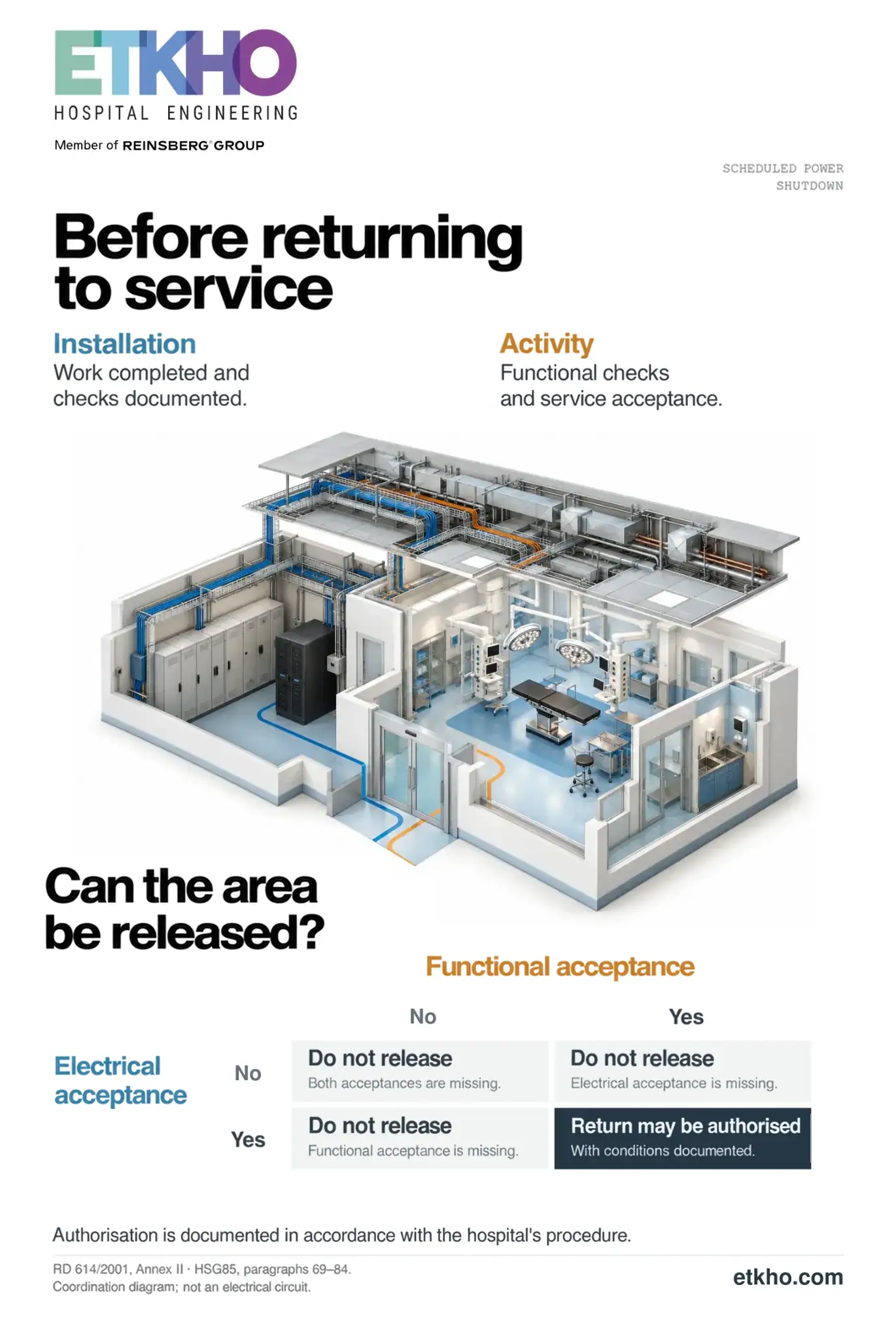
A separate decision follows: whether services can use the area again. As an organisational approach, electrical completion and functional acceptance should be recorded separately. The first documents the condition of the installation after the intervention; the second checks the functions needed for the intended activity and any restrictions that remain.
Power may have returned while the area is still unavailable for use.
Tests are selected according to the scope of the work and the systems affected. They may include checks on supplies, signalling, connected equipment or support services where relevant. Define them before work begins, with acceptance criteria and named responsibilities. Switching on a lamp does not demonstrate that every service in the room is working.
If circuits or configurations have changed, completion documentation must include updated records and the required verification. Technical validation of critical areas places these checks within a documented acceptance process, with a scope proportionate to the modification.
The record needed to prepare the next shutdown
The completion record should let someone who was not present understand the result. Retain the work actually carried out, departures from the plan, checks completed, final restrictions and the identities of those who accepted the return to service. Where changes have been made, the earlier drawing must not remain in circulation as though it describes the current installation.
A subsequent review can focus on differences between the plan and what happened. Did unknown loads emerge? Were any contacts unavailable? Did recovery take longer than expected, or did an alternative supply behave differently? Those observations should lead to specific corrections to the inventory and procedure.
The next shutdown should be prepared using the drawings and records updated after this intervention.
Technical sources
- BOE: Royal Decree 614/2001, Article 4 and Annex II. Spanish requirements for protection against electrical risks; source in Spanish.
- INSST: technical guide to assessing and preventing electrical risks, 2020 edition. Non-binding technical guidance; source in Spanish.
- HSE: Electricity at work: Safe working practices, HSG85, third edition, 2013; paragraphs 18–21, 47–56 and 69–84. UK good-practice guidance.
Frequently asked questions
How should planned power shutdowns in hospitals be prepared?
Define the affected part of the installation, verify its connections to services, agree which activities can continue and check alternative supplies. The plan identifies responsibilities, stop conditions and the evidence needed to accept a return to service. Switching operations are defined in the procedure specific to the installation.
Does having a UPS allow every activity to continue during a shutdown?
Having a UPS does not establish that all affected loads can remain in operation. The available supply path, configuration during the work and required reserve must be checked. The hospital accepts continuity arrangements for each service according to its activities and equipment.
Who authorises electrical work and who accepts the return to clinical use?
Electrical work is authorised under applicable law and the installation procedure by people with the required authority. Acceptance of clinical use follows the arrangements designated by the hospital, involving technical staff and the affected services. The two decisions should be recorded separately.
What should happen if an unidentified load is found?
An unidentified load requires a review of the scope and its consequences. It must be reported to the person responsible for the intervention and assessed before the work is changed. The original authorisation should not be treated as automatic approval of conditions that differ from those planned.
Is restoring power enough to reopen an operating theatre?
Restoring power does not verify every function needed to use an operating theatre. Alongside electrical completion, the systems affected by the intervention must be checked and functional acceptance documented under the hospital’s procedure. The tests depend on the actual scope of the work.
Which records should be kept after the shutdown?
Retain the scope of work completed, the log of system-state changes, incidents, verification results and final restrictions. Identify who accepted the return to service and update any drawings or configurations that have changed, so that the next intervention starts with accurate information.
Prepare the intervention with a clearly defined scope
If the next shutdown affects a critical area, gather the current drawings, load list and proposed backup configuration. ETKHO’s electrical safety advice can support assessment of the installation and its electrical conditions. Authorisation of the work and acceptance of clinical activity remain with the people designated for the project.