


Cybersecurity in hospital electrical systems has become a key factor in modern healthcare engineering. Digitalization has transformed electrical installations into interconnected systems, where monitoring, supervision, and continuity of service increasingly depend on digital platforms.
In this context, solutions developed by ETKHO make it possible to integrate electrical safety and advanced control in critical areas. However, this evolution also introduces a new challenge: ensuring that electrical data remains reliable, secure, and protected against potential manipulation.

Electrical safety no longer depends solely on physical design, but also on the reliability of the digital systems that monitor it.
From Electrical Installations to Intelligent Systems
Hospital infrastructures have evolved into models where energy is not only distributed, but also monitored, analyzed, and managed in real time. This transformation is especially visible in ETKHO’s IT power supply systems, designed for critical environments such as operating rooms and ICUs.
These systems allow the electrical supply to continue even in the event of a first insulation fault, preventing interruptions that could compromise clinical procedures. In addition, they integrate medical isolation transformers, automatic switching systems between main and emergency power, and communication capabilities with external platforms. This connectivity improves efficiency and control, but also increases the need to protect the digital layer managing this information.
To better understand how they work, it is useful to review the technical content on what an IT system is, which explains how these systems electrically isolate installations and allow fault detection without interrupting the supply.

Real Risks in Connected Hospital Electrical Systems
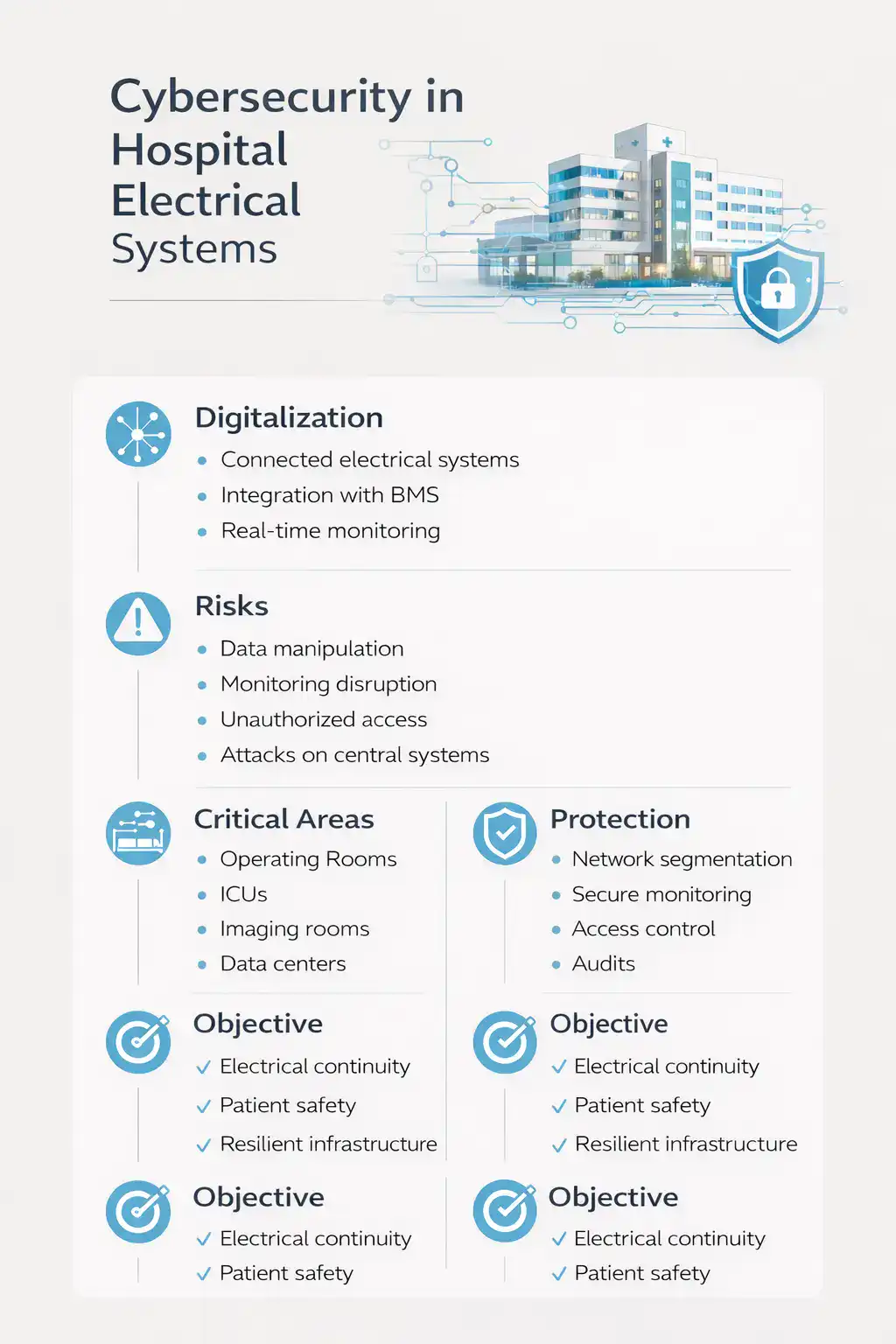
When electrical infrastructure is integrated with digital systems, risk is no longer purely physical. New scenarios emerge in which data manipulation or monitoring failures can directly impact electrical safety.
Monitoring manipulation
Insulation monitoring systems rely on real-time data. If this data is altered or becomes unreliable, it may create a false sense of security, hiding existing faults in the installation.
In this context, ETKHO’s insulation monitoring devices continuously supervise insulation resistance, detect anomalies early, and trigger alarms before issues escalate. Their integration with repeaters and fault location systems enables fast and precise response.
Loss of system visibility
A failure in the digital layer can leave the system without visibility of its actual condition. This prevents timely detection of overloads, insulation faults, or thermal anomalies in transformers.
In hospital environments, this loss of visibility is particularly critical because it reduces anticipation capacity and turns manageable faults into potentially serious incidents.
Impact on continuity systems
Backup systems are also part of this connected ecosystem. ETKHO’s uninterruptible power supply (UPS) systems ensure continuity of supply in case of power failure, automatically activating and keeping critical equipment operational.
However, as they are integrated into monitoring networks, they also require protection against unauthorized access or communication failures, as any disruption in their control can compromise their performance.
These risks align with warnings from the European Union Agency for Cybersecurity, which identifies the healthcare sector as one of the most vulnerable within critical infrastructures.

A digital failure that prevents detecting an electrical issue can be more dangerous than the electrical fault itself.
Hospital Areas with Higher Exposure
The impact of these risks is particularly significant in environments where electrical dependency is absolute.
Operating rooms
Operating rooms require total continuity of supply and systems capable of detecting faults immediately. Here, the combination of IT systems, insulation monitoring, and ETKHO’s medical isolation transformers ensures electrical separation and patient safety.
ICU
In intensive care units, the continuous dependence on electromedical equipment makes reliable monitoring essential. Safety depends not only on power supply but also on proper equipotential bonding. ETKHO’s hospital grounding systems help prevent contact voltages and ensure safe distribution of electrical potentials.
Imaging rooms
These areas require extremely stable power supply. Even small disturbances can affect both equipment performance and diagnostic accuracy.
Hospital data centers
They act as the control core of the hospital. A failure here can indirectly impact all monitored electrical systems.
How to Protect Electrical Infrastructure in Connected Hospitals
Protection is not about reducing digitalization, but about managing it correctly.
Network segmentation separates electrical systems from IT networks, limiting the spread of incidents. Secure monitoring ensures data integrity and anomaly detection, especially when using solutions specifically designed for hospital environments.
Access control, through defined roles and activity traceability, reduces the risk of manipulation. Finally, periodic audits help identify vulnerabilities and continuously improve security, in line with frameworks such as the National Institute of Standards and Technology.

Hospital Engineering: Towards Resilient Environments
Hospital engineering is evolving towards infrastructures where electrical safety and cybersecurity are part of the same system.
This means designing installations capable of early fault detection, maintaining continuity even in adverse scenarios, and securely integrating electrical and digital systems. All of this must align with standards such as IEC 60364-7-710, which regulates electrical installations in medical locations, as well as international standards published by the International Electrotechnical Commission.
Conclusion
Cybersecurity in hospital electrical systems is now a natural extension of electrical safety. In a connected and monitored environment, ensuring safety means protecting both the physical installation and the data that defines it.
The integration of solutions such as IT systems, insulation monitoring, power continuity systems, and grounding solutions enables hospitals to become safer, more resilient, and better prepared for increasingly demanding environments.