


Protection coordination in hospitals is essential to prevent a localized electrical fault from affecting critical areas that are not involved in the incident. In operating rooms, ICUs, diagnostic rooms, laboratories or areas with sensitive electromedical equipment, detecting a fault is not enough: the right protection must operate at the right point, with the lowest possible impact on continuity of care.
When an installation is not properly coordinated, a localized incident can cause unnecessary upstream disconnections, power loss in unaffected circuits or loss of supply in areas that must remain operational. For this reason, selective coordination of protections is part of an advanced hospital electrical safety strategy.
Protection coordination in hospitals helps limit the impact of an electrical fault, preventing critical disconnections and reinforcing operational continuity in sensitive areas.
In a hospital, the best protection is not the one that disconnects fastest, but the one that operates exactly where it should.
What protection coordination in hospitals means
Protection coordination in hospitals consists of designing, adjusting and validating electrical protection devices so that, when a fault occurs, only the device closest to the affected point operates.
Its purpose is not only to protect the installation, but to prevent a localized incident from causing a general disconnection or affecting other hospital areas that are not related to the fault.
In practice, proper coordination must consider:
- the hierarchy between upstream and downstream protections;
- the clinical criticality of each area;
- the expected behavior in the event of overloads, short circuits or insulation faults;
- the relationship between protections, medical IT systems, UPS systems and transformers;
- the traceability of alarms, trips and incidents.
| Concept | What it means | Impact on the hospital |
|---|---|---|
| Electrical protection | Device that operates in the event of overloads, short circuits, leakage or faults | Reduces electrical risks for people, equipment and the installation |
| Coordination | Ordered relationship between upstream and downstream protections | Prevents unnecessary trips in unaffected areas |
| Electrical selectivity | Ability to isolate only the faulty section | Improves service continuity in critical areas |
| Operational continuity | Maintenance of electrical service in unaffected circuits | Protects clinical activity, equipment and patient safety |
ETKHO addresses this need through solutions focused on hospital electrical safety, especially in areas where electrical continuity is critical.
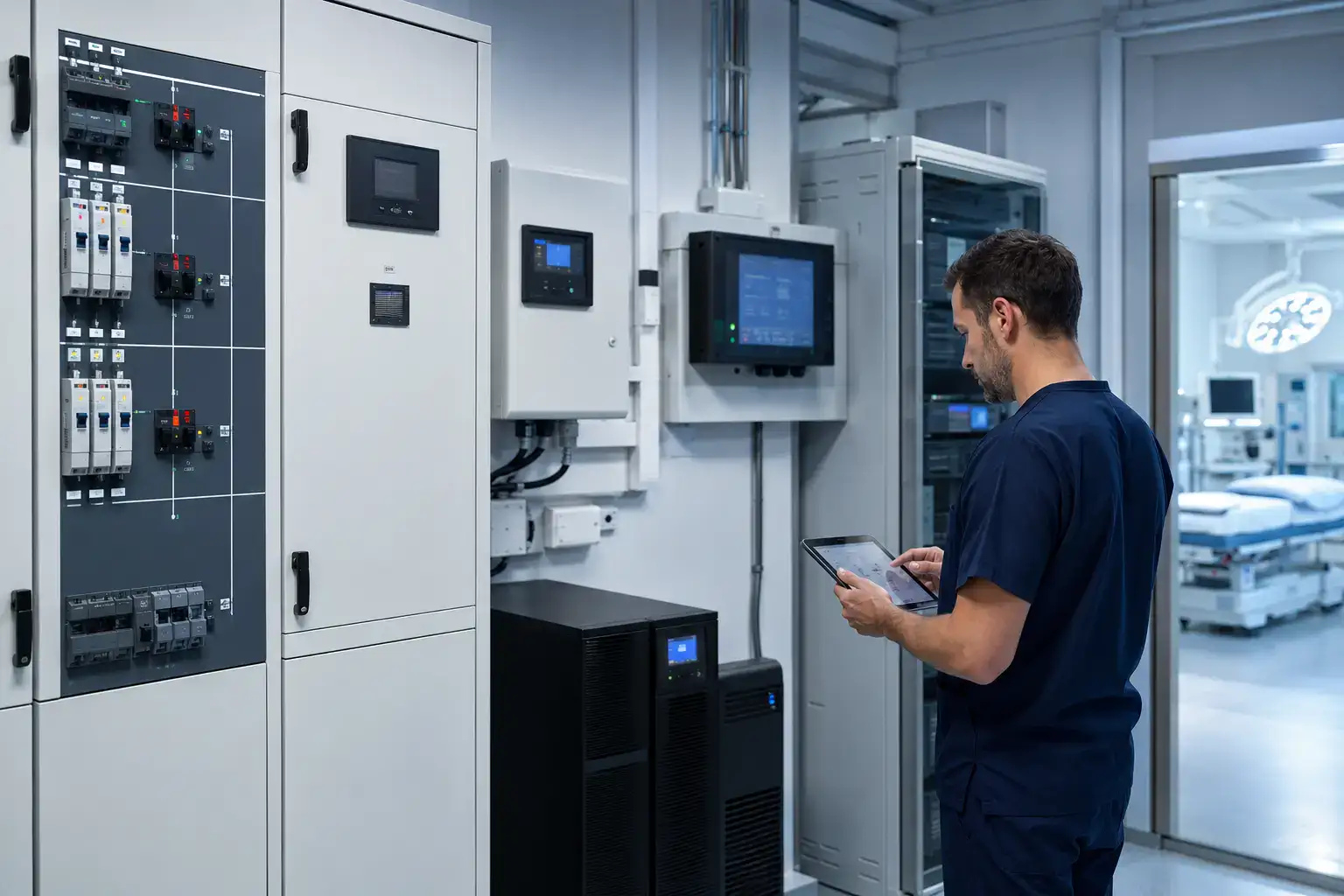
Why electrical selectivity is critical in hospital areas
In conventional buildings, an electrical disconnection may cause a loss of comfort, productivity or service. In a hospital, it can directly affect clinical processes, electromedical equipment or areas where patients depend on continuous electrical systems.
For this reason, hospital electrical selectivity must be designed according to the criticality level of each area. Not all loads have the same operational impact, and not all areas can tolerate the same interruption margin.
The most sensitive areas usually include:
- operating rooms;
- ICUs;
- recovery rooms;
- diagnostic imaging;
- laboratories;
- technical rooms;
- areas with sensitive electromedical equipment.
In operating rooms and ICUs, the priority is to maintain continuity after a first fault and avoid general disconnections. In laboratories or diagnostic imaging areas, electrical stability and equipment availability may be decisive to preserve processes, samples or clinical tests.
Hospital electrical selectivity is not only about protecting circuits: it is about protecting clinical continuity.
Technical reference guidelines for hospital electrical services, such as the NHS Health Technical Memorandum 06-01, reinforce the importance of properly designing, operating and maintaining electrical infrastructure in healthcare buildings.
Similarly, the Scottish Health Technical Memorandum 06-01 addresses criteria for work on fixed wiring and integral electrical equipment used in healthcare electrical services, an approach directly aligned with continuity and safety in critical installations.
The difference between detecting a fault and isolating it correctly
One of the most common mistakes when analyzing hospital electrical safety is confusing detection with resolution. Detecting an alarm or deviation is only the first step. After that, the installation must be prepared so that the electrical response is proportional and localized.
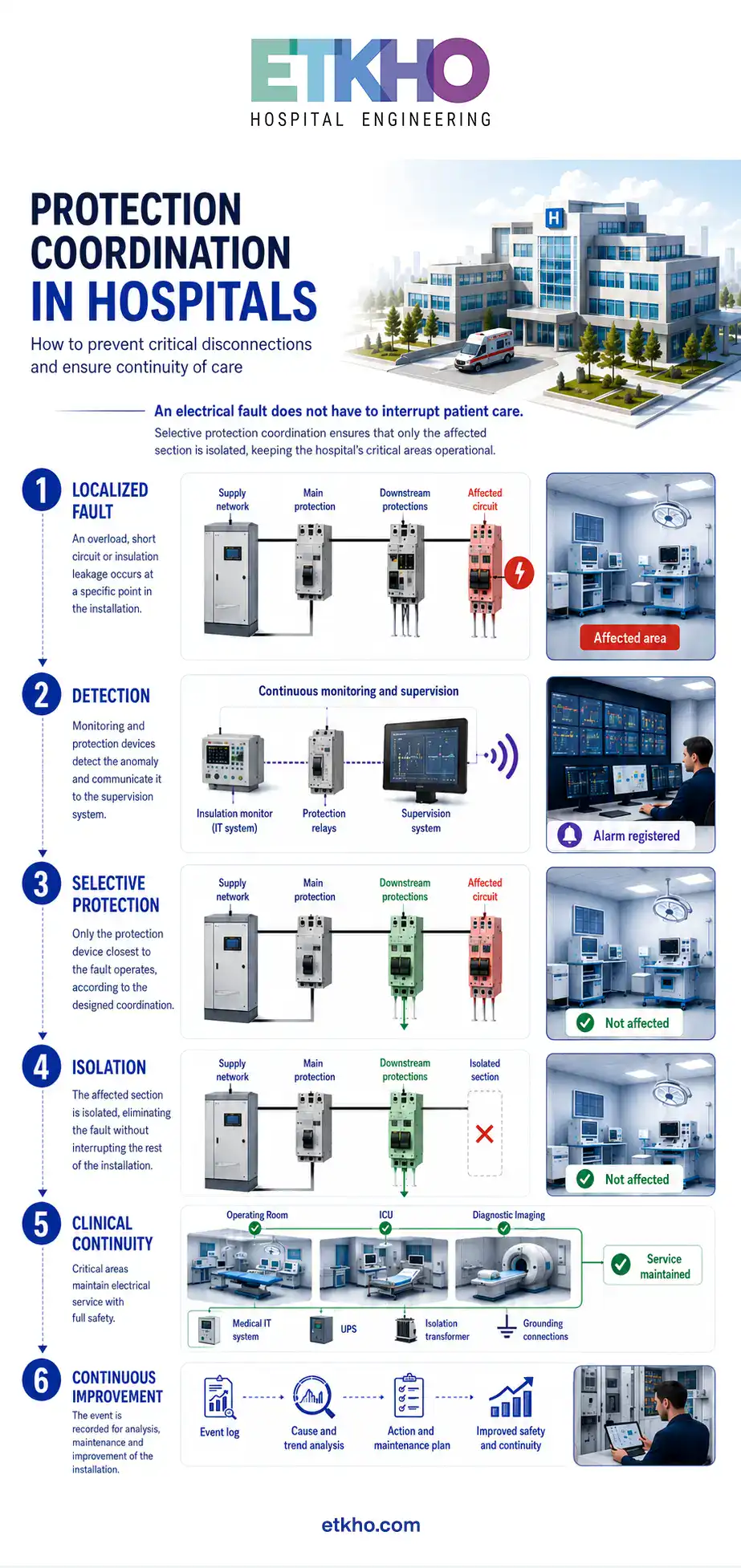
This process can be understood as a technical sequence:
- Detection: the system identifies an electrical anomaly.
- Interpretation: the technical team assesses the risk and the affected area.
- Isolation: the corresponding protection operates.
- Continuity: unaffected areas remain operational.
- Logging: the incident is documented for maintenance and continuous improvement.
This approach connects naturally with the management of hospital technical alarms, where the priority is to detect, communicate and prioritize electrical incidents. Protection coordination adds the next level: ensuring that the installation responds precisely to the fault.
An alarm indicates that something is happening. A properly coordinated protection system decides how far the impact of that fault should go.

Types of electrical selectivity in hospital installations
Electrical selectivity can be approached in different ways depending on the architecture of the installation, the devices used and the criticality level of the area.
In hospitals, the goal is not to apply a single generic solution, but to select the appropriate strategy according to clinical risk, electrical architecture and continuity requirements.
| Type of selectivity | How it works | Hospital application |
|---|---|---|
| Total selectivity | Only the protection closest to the fault operates across the entire expected range | Areas where maximum service continuity is required |
| Partial selectivity | Coordination is guaranteed up to a specific current level | Areas with lower criticality or lower operational requirements |
| Current-based selectivity | Based on current differences between protections | Staged distributions with differentiated loads |
| Time-based selectivity | Based on coordinated operating times | Installations where trip timing must be controlled |
| Logical selectivity | Integrates communication between protections or systems | Complex infrastructures with advanced supervision |
In critical areas, this decision must be integrated with the electrical system design, load classification, the IEC 60364-7-710 standard and technical response protocols.
Coordination with medical IT systems and insulation monitoring
IT power supply systems play a key role in critical medical areas because they help maintain service continuity after a first insulation fault.
In this type of system, the priority is not to disconnect immediately, but to detect the deviation, alert the technical team and enable a controlled intervention. To do this, insulation monitors supervise the status of the installation and activate alarms when abnormal conditions are detected.
Coordination with medical IT systems must consider three aspects:
- continuity after a first insulation fault;
- fast localization and interpretation of the deviation;
- selective operation when the fault evolves or affects a specific section.
To reinforce this point, the technical explanation of what an IT system is helps explain why it is especially relevant in medical environments where electrical continuity is a priority.
In critical areas, electrical protection must allow action without turning every deviation into an immediate interruption.
UPS, transformers and upstream protections
Protection coordination cannot be analyzed in isolation. It must consider how protections relate to other elements of hospital electrical infrastructure, especially UPS systems, isolation transformers and upstream protections.
Uninterruptible power supply systems help protect sensitive equipment against interruptions, micro-outages or grid disturbances. Medical isolation transformers, in turn, reinforce electrical separation and safety in critical areas.
Poor coordination can cause:
- unexpected trips in general protections;
- loss of power supply in unaffected circuits;
- inadequate operation during downstream short circuits;
- difficulty identifying the real origin of the incident;
- lower operational recovery capacity after the fault.
Hospital electrical continuity depends both on energy backup and on the precision with which a fault is limited.
Coordination between UPS systems, transformers and protections allows the response to be proportional, without compromising circuits that must remain available.
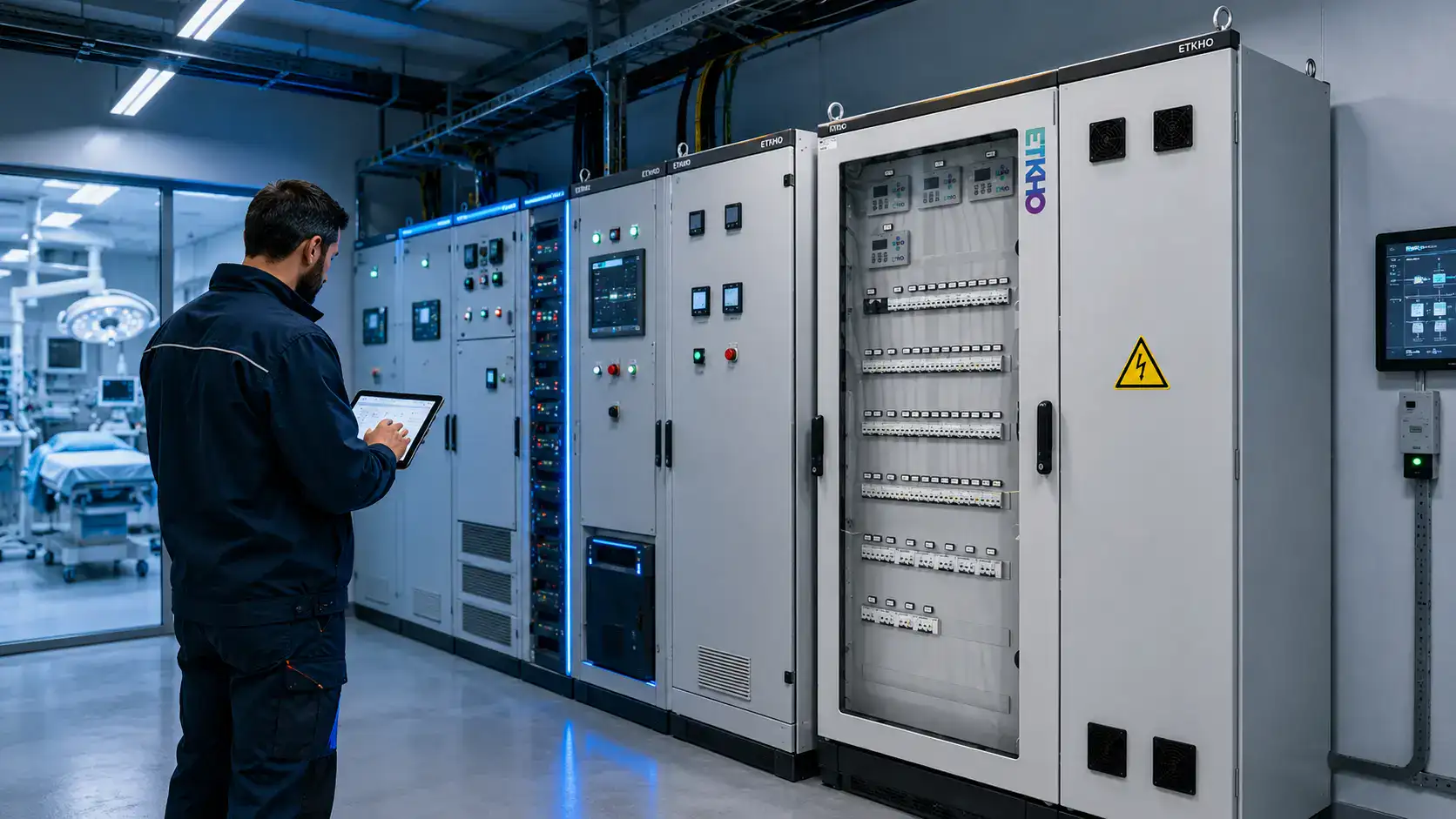
Common mistakes in hospital protection coordination
A hospital installation may have suitable protections and still present risks if those protections are not properly coordinated. The problem is not always the lack of devices, but how they relate to each other.
| Common mistake | Consequence | How to prevent it |
|---|---|---|
| Analyzing protections in isolation | Non-selective trips or unnecessary disconnections | Study the installation as a complete system |
| Not differentiating areas by criticality | The same criterion is applied to areas with very different risks | Classify areas according to clinical and operational impact |
| Not validating settings after load changes | Coordination may become outdated | Review protections after extensions or refurbishments |
| Not integrating alarms and supervision | Lower visibility over the origin of the incident | Connect protections, alarms and monitoring |
| Not documenting incidents | Loss of information for maintenance | Log events and review fault patterns |
This approach is also related to predictive maintenance in hospitals, since interpreting electrical events, alarms and trends makes it possible to anticipate problems before they affect clinical activity.
How to validate coordination during hospital commissioning
Protection coordination should not remain only in the design phase. It must be reviewed and validated during start-up, especially in critical areas where an electrical fault may have significant operational consequences.
During hospital commissioning, it is advisable to verify that protections, alarms, IT systems, UPS systems and transformers respond according to the planned logic.
Validation should include:
- review of the electrical architecture and protection hierarchy;
- verification of settings and tripping curves;
- functional testing of alarms and signaling;
- continuity checks under expected scenarios;
- documentation of criteria, configurations and results.
A critical installation should not be considered ready until its response to faults has been tested, understood and documented.
Validating coordination not only reduces risks during start-up. It also facilitates maintenance, future expansion of the installation and response to real incidents.
ETKHO solutions for electrical continuity and protection in critical areas
Protection coordination in hospitals requires a combination of technical design, suitable products, supervision and validation. ETKHO provides solutions designed to preserve electrical safety in critical areas and support the technical management of the installation.
| Hospital need | Related ETKHO solution | Role in electrical continuity |
|---|---|---|
| Maintain service after a first fault | IT power supply systems | Prevent immediate interruptions in critical medical areas |
| Detect insulation deviations | Insulation monitors | Help identify abnormal conditions before a major incident occurs |
| Protect sensitive equipment | Uninterruptible power supply systems | Provide backup against interruptions or grid disturbances |
| Reinforce electrical separation | Medical isolation transformers | Contribute to electrical protection in sensitive areas |
| Improve equipotential bonding | Hospital grounding connections | Help maintain safe grounding conditions |
| Assess risks and technical criteria | Electrical safety consulting | Supports short-circuit analysis, protection coordination and power quality assessment |
The combination of these solutions helps hospital electrical infrastructure not only detect faults, but respond in a proportional, localized and safe way.
Conclusion
Protection coordination in hospitals is essential to ensure electrical continuity in critical areas. Its role is not limited to protecting the installation; it also prevents a localized fault from causing unnecessary disconnections in zones that must remain operational.
In environments such as operating rooms, ICUs, diagnostic imaging or laboratories, electrical selectivity helps isolate incidents precisely, preserve clinical activity and enable a safer technical response.
Through medical IT systems, insulation monitoring, UPS systems, isolation transformers, hospital grounding connections and specialized technical consulting, ETKHO helps build safer, better-coordinated hospital infrastructures prepared to respond to electrical faults in critical areas.
Frequently asked questions about protection coordination in hospitals
What is protection coordination in hospitals?
It is the design, adjustment and validation of electrical protections so that, when a fault occurs, the device closest to the affected point operates, avoiding unnecessary disconnections in other hospital areas.
What is the difference between coordination and electrical selectivity?
Coordination is the ordered design of protections. Electrical selectivity is the desired result: only the section affected by the fault is disconnected.
Why is it important in operating rooms and ICUs?
Because in these areas an electrical disconnection can affect electromedical equipment, monitoring, anesthesia, life support or sensitive clinical processes.
How is it related to medical IT systems?
Medical IT systems help maintain continuity after a first insulation fault, while insulation monitors detect deviations and support a controlled technical response.
When should protection coordination be reviewed?
It should be reviewed during design, commissioning, after extensions or refurbishments, after load changes and when repeated electrical incidents are recorded.
Which ETKHO solutions help improve electrical continuity?
IT systems, insulation monitors, UPS systems, isolation transformers, grounding connections and technical consulting services help reinforce hospital electrical continuity and safety.