



Hospital microgrids are becoming a key solution for improving energy resilience, operational autonomy, and hospital electrical safety in critical environments. The increasing electrification of hospitals, the integration of renewable energy, and the need for continuity of care require more flexible, intelligent, and secure electrical infrastructures.
In a hospital, any electrical interruption can directly affect operating rooms, ICUs, imaging rooms, laboratories, or data centers. For this reason, microgrids enable hospitals to generate, store, distribute, and manage energy more autonomously, without relying exclusively on the main electrical grid.
Hospital energy resilience no longer depends solely on electrical backup, but on the hospital’s ability to manage its own energy intelligently and safely.
What hospital microgrids are and how they improve electrical safety
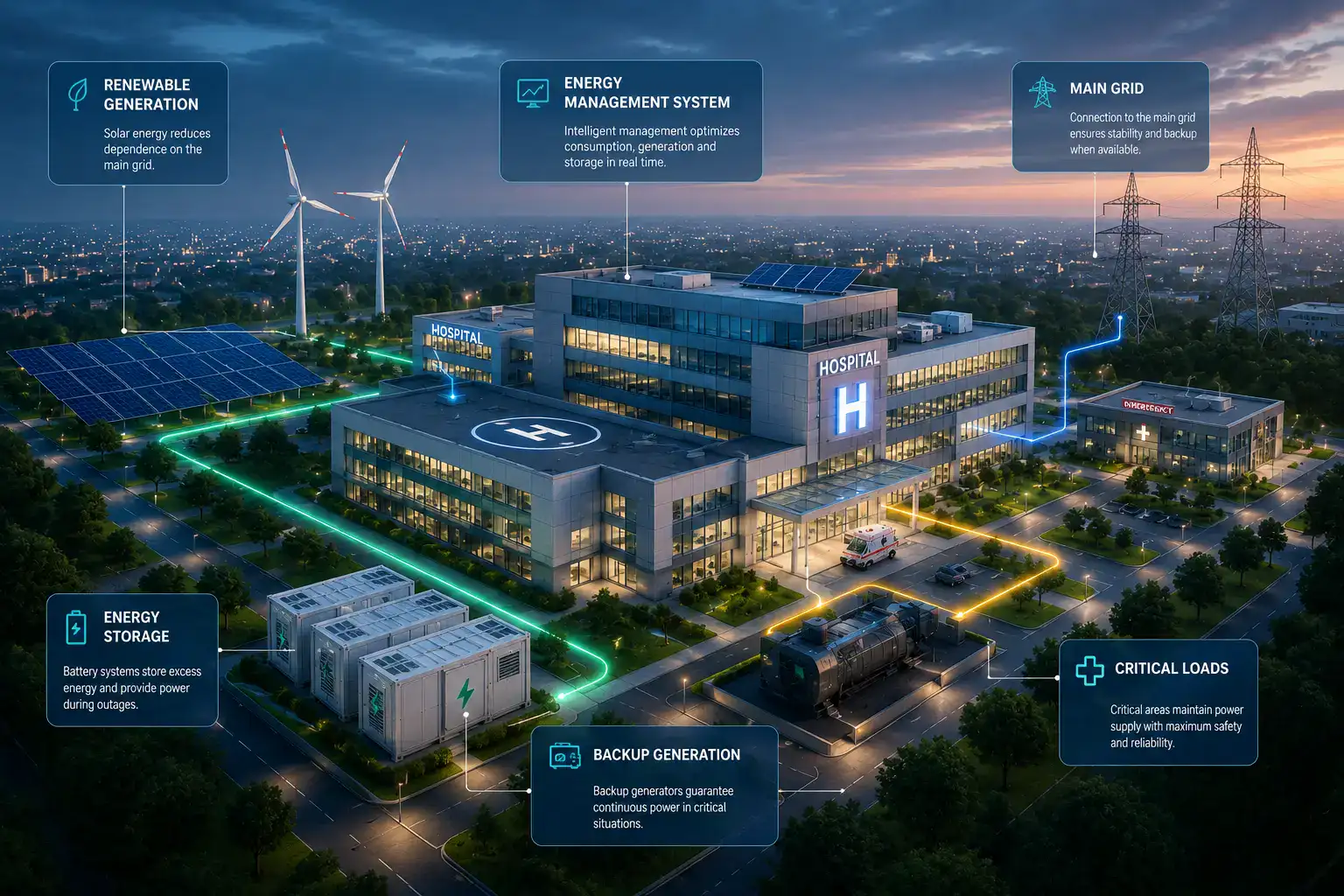
A hospital microgrid is a local energy network capable of generating, storing, distributing, and managing energy autonomously or connected to the main grid. Its goal is to ensure electrical supply even in situations involving failure, instability, or interruption of the external grid.
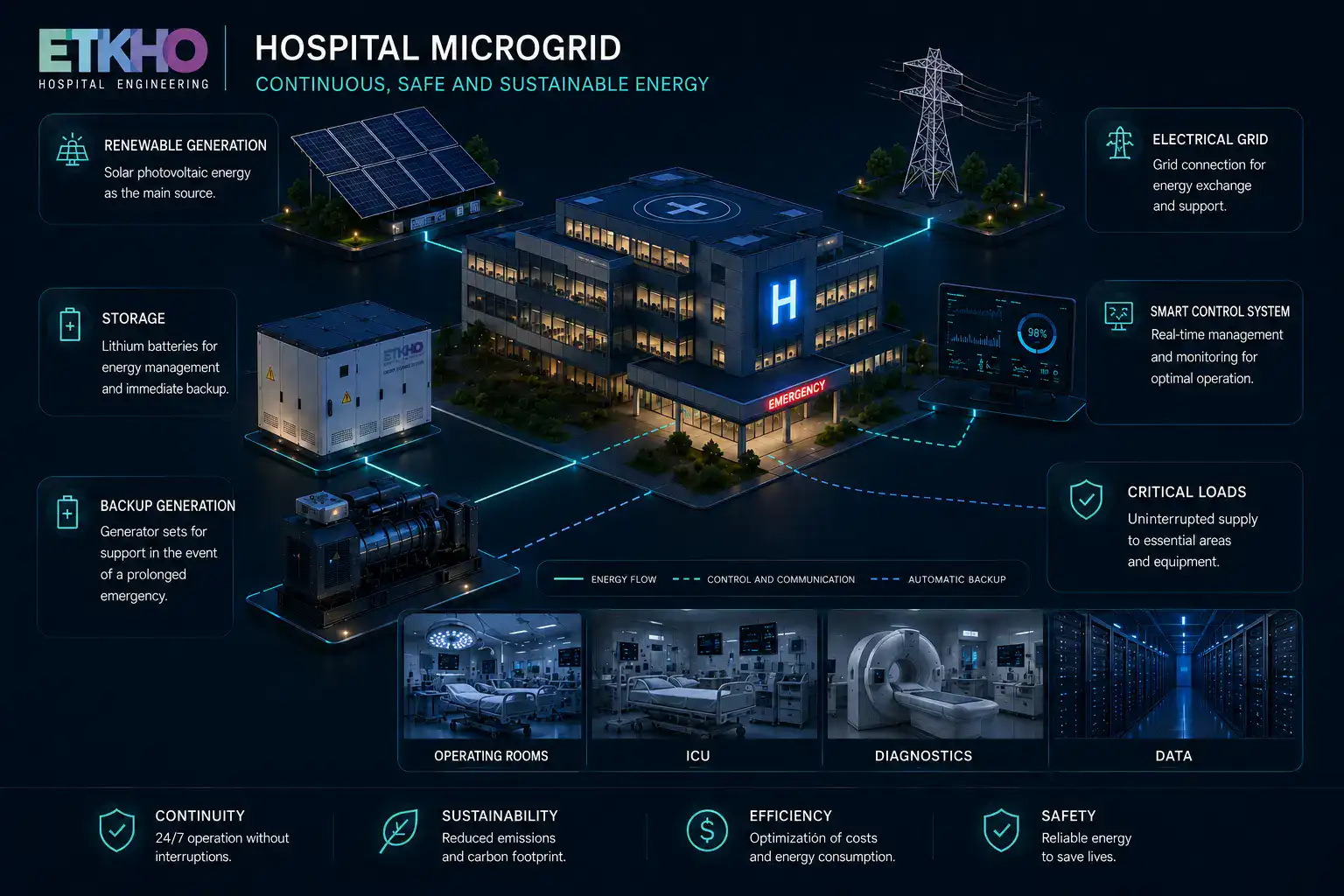
Unlike traditional backup systems, microgrids integrate multiple energy sources and advanced control systems. They can combine photovoltaic generation, energy storage, uninterruptible power supply systems, generators, EMS/BMS platforms, and real-time electrical monitoring systems.
From a hospital engineering perspective, this model represents a natural evolution toward more resilient, sustainable infrastructures prepared for critical scenarios. It is not only about having alternative energy, but about coordinating different sources to ensure continuity, stability, and safety.
In this context, ETKHO IT power supply systems help maintain electrical continuity in critical areas even when incidents occur in the main grid or in part of the installation. In addition, to better understand their role in medical environments, it is useful to review how IT systems work in hospital installations.
Why hospitals need hospital microgrids
Hospitals are among the most energy-sensitive infrastructures. Unlike other buildings, they cannot afford interruptions, voltage fluctuations, loss of electrical stability, or failures in the supervision of critical systems.
The growing dependence on electromedical equipment, continuous monitoring, digital platforms, communication systems, and data centers means that energy continuity is directly related to clinical safety. In this scenario, hospital microgrids help reduce operational risk and improve response capacity in the event of incidents.
Factors such as extreme weather events, saturation of electrical grids, increasing energy demand, cyberattacks on critical infrastructure, and the integration of renewables are accelerating the need to design hospitals capable of operating under adverse conditions.
The International Energy Agency highlights the importance of strengthening energy resilience in critical infrastructures. In healthcare, this need is especially relevant because energy supports not only operational activity, but also continuity of care.
In addition, this evolution is directly connected to the process of energy transition in hospitals, where the integration of renewables, storage, and digitalization requires new hospital electrical safety strategies.
Continuity of care increasingly depends on the hospital’s ability to keep its energy infrastructure operational under any scenario.
How hospital microgrids work
Hospital microgrids work through an intelligent energy architecture capable of coordinating different sources of generation, storage, backup, and consumption in real time. Under normal conditions, they can operate connected to the main grid, optimizing consumption and reducing energy dependence.
However, in the event of an external incident, a microgrid can automatically isolate itself and continue operating autonomously. This island mode capability is key for hospitals where critical services must remain operational even during grid failures or emergency situations.
To achieve this, the microgrid needs advanced monitoring systems, energy automation, management platforms, specialized electrical protection, and a clear hierarchy of priority loads. Not all hospital areas have the same level of criticality, so the system must prioritize operating rooms, ICUs, imaging rooms, laboratories, and data centers.
This is where ETKHO insulation monitors become especially important, as they detect electrical deviations before they evolve into critical failures. In highly digitalized and energy-complex hospitals, this anticipation capacity is essential.
The digitalization of these infrastructures also requires protecting the supervision and control layer. This aspect was already addressed in the article on cybersecurity in hospital electrical systems, where it is analyzed how connectivity improves control, but also introduces new risks.
Integration of renewables, storage, and backup
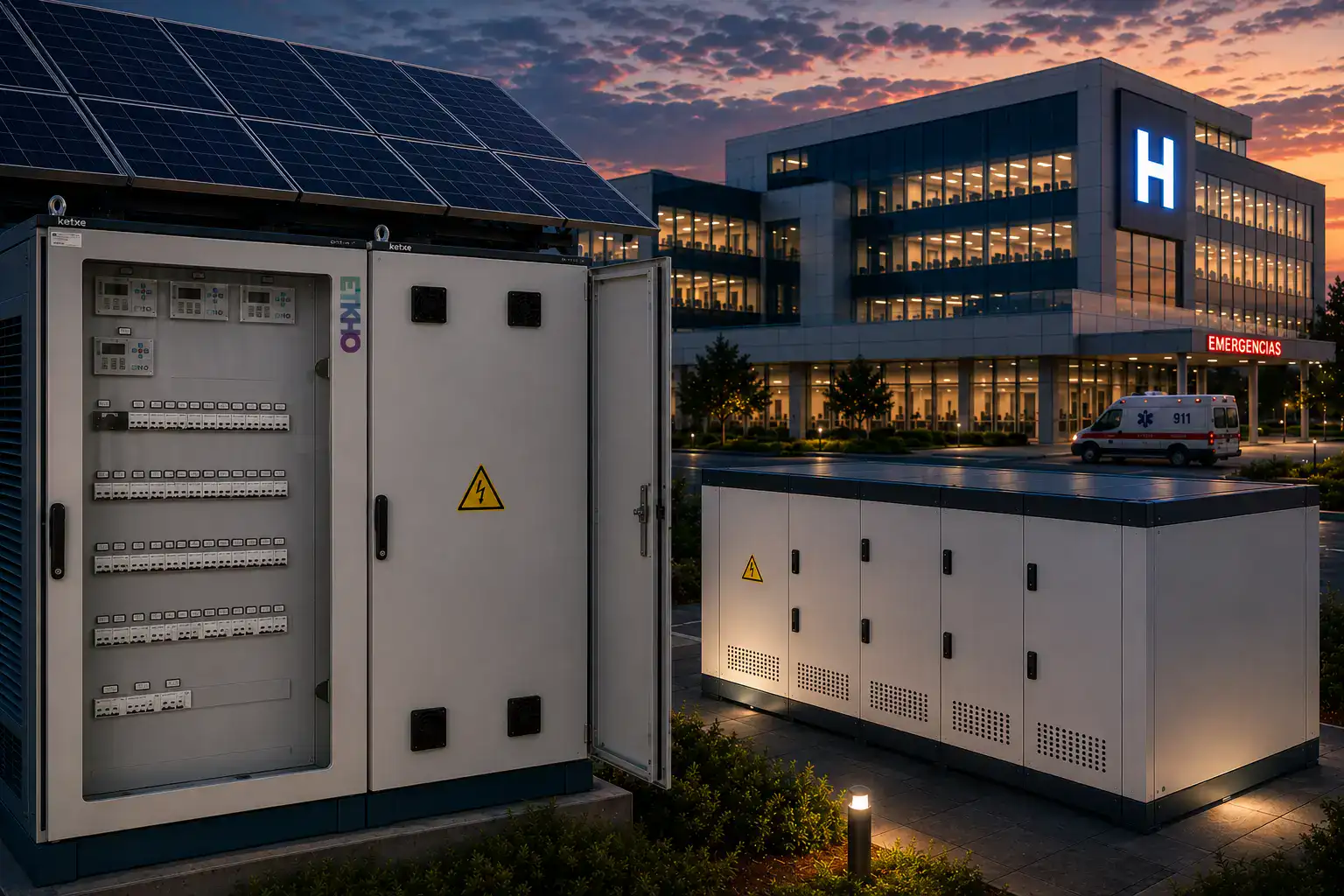
One of the major benefits of hospital microgrids is their ability to integrate renewable energy and storage systems without compromising electrical safety. Photovoltaic generation, batteries, and backup systems can work together to improve autonomy, efficiency, and continuity.
Energy storage makes it possible to accumulate energy during periods of low demand or high renewable generation and use it when the hospital needs it. This reduces dependence on the grid, improves energy stability, and enables more efficient resource management.
However, this integration also introduces new technical challenges. Renewable variability, coordination between sources, voltage and frequency stability, and power quality must be managed under strict criteria. In hospitals, any fluctuation can directly affect the operation of critical equipment.
For this reason, ETKHO uninterruptible power systems are essential to ensure immediate continuity in the event of micro-outages, grid failures, or transitions between energy sources.
Critical areas where hospital microgrids are essential
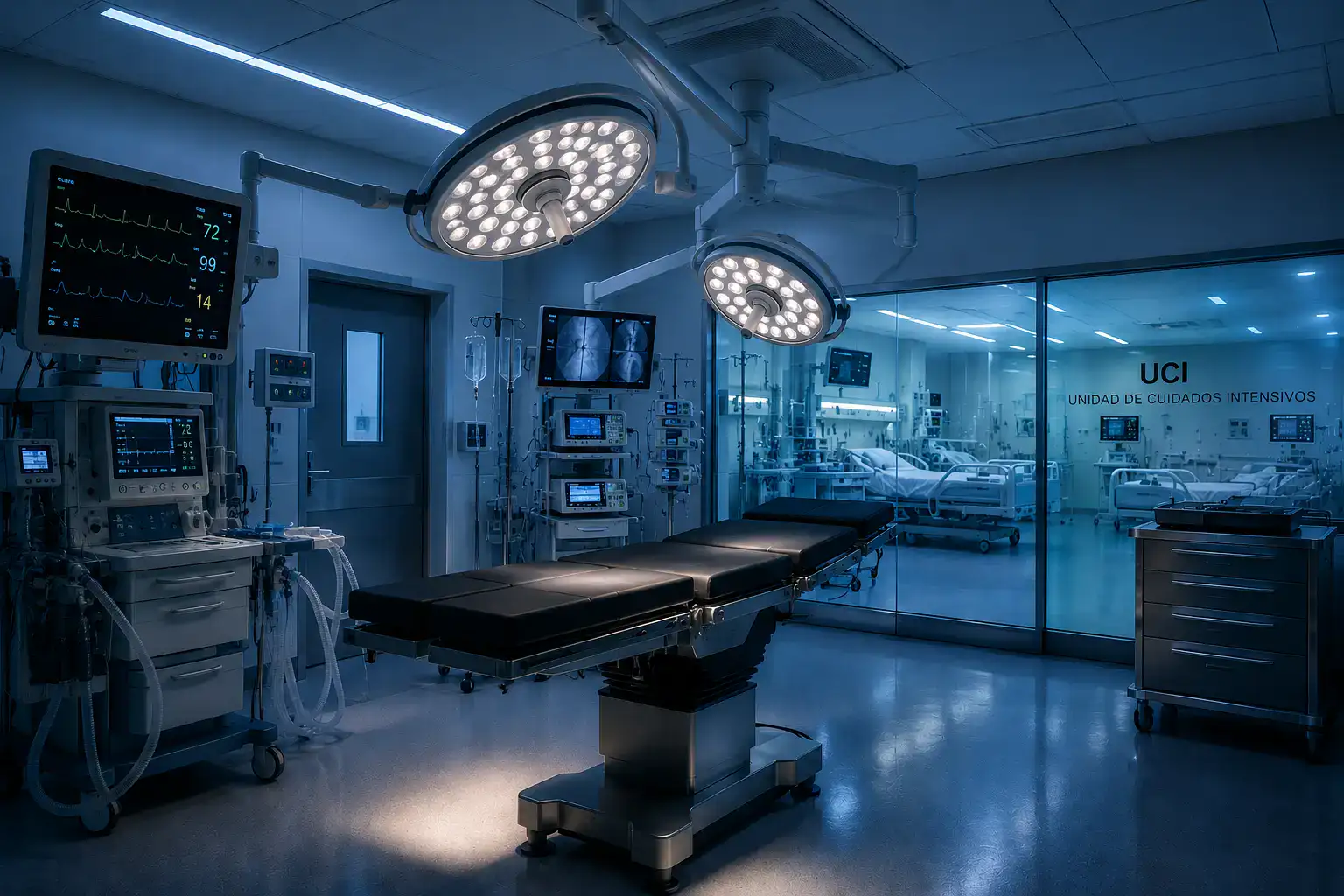
Hospital microgrids do not have the same impact across all areas of a hospital. Their value is especially high in spaces where electrical continuity is essential to maintain clinical activity and protect patients.
Operating rooms
Operating rooms require continuous supply, electrical isolation, and maximum stability. The combination of IT systems and medical isolation transformers helps maintain patient electrical safety and reduce risks associated with interruptions or interference.
ICU
In intensive care units, energy dependence is absolute. Ventilators, monitors, infusion pumps, and life-support systems require constant stability and immediate response capacity in the event of any incident.
In this environment, ETKHO hospital grounding connections help ensure proper equipotential bonding and reduce the risk of contact voltages.
Imaging rooms
Equipment such as MRI scanners, CT scanners, or advanced diagnostic systems require extremely stable power quality. Microgrids help minimize fluctuations, stabilize supply, and protect sensitive equipment.
Hospital data centers
Hospital digitalization makes data centers one of the most critical points in the energy infrastructure. Microgrids improve redundancy, continuity, and recovery capacity in the event of incidents.
Hospital engineering and the design of safe microgrids
The development of hospital microgrids involves a profound change in how healthcare electrical infrastructures are designed. Having backup energy is no longer enough. It is now necessary to design flexible, redundant, monitored systems capable of adapting to changing scenarios.
This requires planning based on resilience, continuity, load segmentation, digital supervision, and advanced electrical protection. It also requires defining which systems must remain operational in each scenario and how critical loads should be prioritized.
The design must align with specific standards such as IEC 60364-7-710, aimed at electrical installations in medical locations, as well as international standards published by the International Electrotechnical Commission.
To address this scenario, it is essential to rely on hospital electrical safety solutions specifically designed for critical environments. In a hospital microgrid, every component must contribute to continuity, patient protection, and the overall reliability of the system.
Hospital microgrids do not only improve energy efficiency: they redefine how continuity and safety are ensured in critical healthcare environments.
Hospital microgrids and energy-autonomous hospitals
The healthcare sector is moving toward increasingly autonomous, digitalized, and resilient hospitals. In the coming years, we will see infrastructures capable of managing their own energy, integrating storage, optimizing demand, and responding automatically to incidents.
This shift will improve sustainability and resilience, but it will also require much more sophisticated electrical infrastructures. Energy autonomy must not compromise hospital electrical safety, especially in areas where continuity of care depends on electrical supply.
The combination of microgrids, advanced monitoring, IT systems, uninterruptible power supply, isolation transformers, and grounding connections will be key to ensuring hospitals are prepared for the energy challenges of the future.
Frequently asked questions about hospital microgrids
What is a hospital microgrid?
A hospital microgrid is a local energy network capable of generating, storing, and managing energy autonomously or connected to the main grid, ensuring electrical continuity in critical environments.
Why are hospital microgrids important?
They are important because they increase hospital energy resilience and allow critical systems to remain operational even during grid failures, external incidents, or supply interruptions.
What technologies do hospital microgrids integrate?
They integrate renewable energy, energy storage, uninterruptible power supply systems, monitoring platforms, automation, and advanced electrical protection systems.
Which hospital areas depend most on a microgrid?
Operating rooms, ICUs, imaging rooms, critical laboratories, and hospital data centers are the areas most sensitive to any electrical interruption.
How do microgrids contribute to hospital sustainability?
They enable the integration of renewables, optimize energy consumption, reduce emissions, and increase overall hospital efficiency without compromising electrical safety.
What role does hospital engineering play in microgrid design?
Hospital engineering must design resilient, safe systems capable of integrating multiple energy sources while maintaining continuity, stability, and protection in critical areas.
Conclusion
Hospital microgrids represent one of the most important advances within the healthcare energy transition. Their ability to integrate distributed generation, energy storage, and intelligent control improves energy resilience and ensures continuity of care in critical hospitals.
However, this evolution also increases the complexity of hospital electrical infrastructure. For this reason, the design of energy-autonomous hospitals must be based on strict criteria for hospital electrical safety, stability, and continuous monitoring.
At ETKHO, we develop specific solutions to ensure electrical safety in critical hospitals, helping to integrate energy resilience, continuity, and advanced electrical protection into modern healthcare infrastructures.